
Introduction
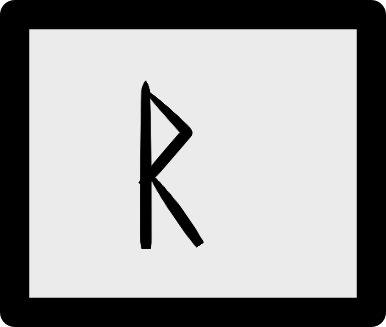
The Rad (Raidho) rune is associated with movement, ordered progress, and the structure of journeys within early Germanic societies. Its meaning is grounded in the practical realities of travel, communication, and the coordination of people and goods across distance.
In historical contexts, Rad appears within inscriptions as part of a functional writing system, contributing to meaning through its placement within words and phrases rather than acting as an isolated symbol.
Rad (Raidho) in Historical Context
The name of the rune is linked to rād, referring to riding or travelling, often in a structured or purposeful sense rather than random movement. In the early medieval period, journeys were shaped by routes, obligations, and relationships, whether for trade, governance, or communication.
Movement was not simply physical but organised, reflecting systems of exchange and interaction. The Rad rune reflects this idea of directed progress, where travel follows established patterns and serves a defined purpose.
Use in Runic Inscriptions
Rad appears within runic inscriptions as part of a structured writing system, where its role is determined by its position within names and words. Like other runes, it contributes to meaning through context and sequence rather than functioning independently. Surviving material suggests that runic writing prioritised clarity and efficiency, with each character forming part of a deliberate and economical expression.
Rad (Raidho) in Modern Design
When incorporated into engraved rune rings, Rad reflects movement, order, and continuity, expressed through clear and balanced forms. Designs are developed with attention to proportion and historical grounding, avoiding decorative reinterpretation in favour of structural integrity.
Each piece begins as original artwork informed by inscriptions and artefacts, then refined for precision engraving and everyday wear.